

Prasad: The Way to Disarmament

No Gravatar

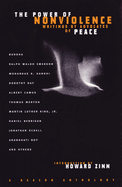
The Power of Nonviolence: Writings by Advocates of PeaceThe fifteenth chapter of The Power of Nonviolence: Writings by Advocates of Peace contains Rajendra Prasad‘s 1963 essay  The Way to Disarmament.  Like the recently discussed writings by Merton, Fromm, and Muste, finding the path to peace through disarmament is the focus of Prasad’s  essay. Dr. Prasad spent his life working for Indian independence and was the first President of the Republic of India. He wrote the essay a year before he died.

Prasad decries the technological advance of warfare. He found that this “misuse” of science and techonolgy vastly increased the scale of human life that was destroyed, and seperated the destructive act from the realization that human life was being taken.  His discussion is immediately relevant to the use of drones to murder today. Prasad looks to his contemporaries for guidance on how to move foraward”

This is what Mahatma Gandhi meant when he said that ultimate nonviolence was only safe defense not only for the individual but for nations.   Continue reading

Merton: The Root of War is Fear

No Gravatar

The Power of Nonviolence: Writings by Advocates of PeaceThe fourteenth chapter of The Power of Nonviolence: Writings by Advocates of Peace contains Thomas Merton‘s 1962 essay  The Root of War is Fear.  As we have seen in the essays by Muste, Day, Addams, Gandhi, and Penn, religious conviction can be a great motivator to speak out for pacifism. Adopting the contemplative life of a monk, seems to have propelled Merton outward into addressing war and violence.

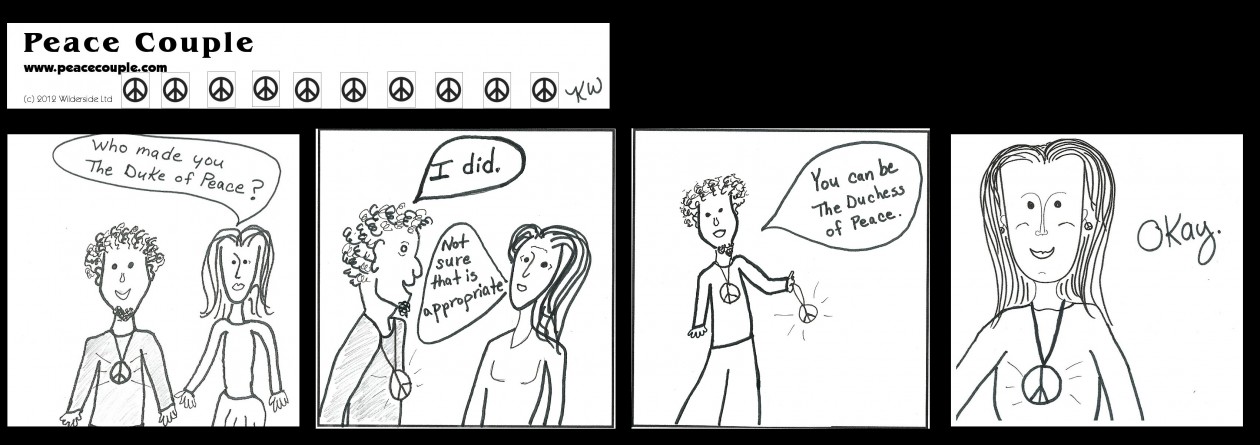
The title of Merton’s essay remind me of what the Duchess always says, “That which is not love, is fear.”   Like Fromm’s essay of the prior week, Merton diagnoses the especially American idea that the only way to peace is through nuclear war as being a form of mental illness.

Merton immediately questions what is a Christian to do in a world where violence is considered to be the only answer. He quickly turns aside the choices of resigning oneself to the inevitability of the situation, using it as a reason to preach Apocalypse, or celebrating a nuclear victory over Atheist Communism.Merton finds there is only one appropriate response for a Christian:

That task is to work for the total abolition of war.

Continue reading

A Peaceful Mother’s Day: Thoughts, Gift Ideas, and The Proclamation

No Gravatar

In the US, Mother’s Day started out as a holiday about peace. Initially mothers of soldiers who died in both sides of the Civil War would meet to try to reconcile.  The most famous example of the peaceful intent of Mother’s Day is the Proclamation by Julia Ward Howe.  She is best remembered as the abolitionist, pacifist, and suffragist poet who penned the Battle Hymn of the Republic. The proclamation is at the bottom of this post. In between are some peaceful gift suggestions for your mother,

Let’s start with a peaceful way to wrap your present:

Gift Wrap Paper Seeded with Wild Flowers for planting

Flowering gift wrapping paper that can be planted after it wraps a gift!  Continue reading

Fromm: Unilateral Nuclear Disarmament

No Gravatar

The Power of Nonviolence: Writings by Advocates of PeaceThe thirteenth chapter of The Power of Nonviolence: Writings by Advocates of Peace  contains Erich Fromm‘s 1960 essay  The Case for Unilateral Disarmament.  Fromm was a psychoanalyst and a member of the Frankfurt School.  He co-founded the anti-nuclear organization SANE, which as named after his 1955 book, The Sane Society.  SANE is now part of Peace Action.

Like Muste and Wallace, Fromm argues that the safest path to security is unilateral disarmament.  Not surprisingly, Fromm approaches the discussion from a psychological perspective.  To start with he pushes aside the question of whether disarmament is unilateral or mutual.  Instead, he reaches for the question of what the reaction of the opposing side will be to disarmament. He rather dryly states that

it is unfortunately true that political leaders can rarely be trusted

Fromm’s purpose is not to demonize political leaders; he argues that the human nature causes them to bifurcate their personal moral beliefs from their morality as institutional leaders.   He finds Hitler to be personally immoral, but the Russian [sic] leaders to be moral in their personal beliefs.  Continue reading

Dance, Recite, and Converse for Earth Day!

No Gravatar

For this Earth Day, we wanted to share with you some of the movies, music, and books that have inspired us to joyfully engage in our environmental activism.

Mindwalk.  This movie is a favorite of Ian’s.  It is based on the book Turning Point by physicist Fritjof Capra.  Capra is best know for his book, The Tao of Physics which removes the artificial barriers between religious understanding and scientific understanding.  The book, The Turning Point, presented the movie maker’s problem of how to turn a book about the complexity of our ecological problems into a narrative.  The solution was to set it in a beautiful place,  Mont. St. Michael, France.  And set in motion a discussion between a physicist (Liv Ullmann) and poet (John Heard), and a former presidential candidate  (Sam Waterston) as they walk through Mont. St. Michael.  The narrative form also provided a solution to a lesser problem.  There was already a very famous ballet movie called Turning Point, so the Capra’s movie was named Mindwalk to avoid confusion and reflect the new form.

  Continue reading

Nonviolence: Muste’s Getting Rid of War

No Gravatar

The Power of Nonviolence: Writings by Advocates of PeaceThe twelfth chapter of The Power of Nonviolence: Writings by Advocates of Peace  contains A.J. Muste‘s 1959 essay  Getting Rid of War.  The essay leads off the third section of the book:  The Cold War and Vietnam. Muste’s life was a journey toward pacifism and through politics and religion.  He was a labor organizer, anti-war leader and civil rights mentor.

Muste seeks a path to “abolish war and the benumbing threat of nuclear destruction.”  He defines the problem as having two “characteristics”: 1) the cancerous growth of weapons of mass destruction, and 2) the political intransigence between the Western and Eastern blocs.  The first problem has not been resolved.  The second has only changed players, but the fight over resources has not.  Continue reading

Wallace’s Are We Only Paying Lip Service to Peace?

No Gravatar

The Power of Nonviolence Writings by Advocates of PeaceThe twelfth chapter of The Power of Nonviolence: Writings by Advocates of Peace  contains former Vice President Henry Wallace’s 1946 essay  Are We Only Paying Lip Service to Peace?.  Wallace ran for President on the Progressive Party line in 1948 campaigning in support of integration, equal voting rights, single-payer universal healthcare, and peaceful relations with the Soviet Union.

Like Camus’ Neither Victims nor Executioners of the same year, Wallace is concerned that World War II allies — the US and USSR  — were heading straight into a third world war.  Possibly the first — and last — nuclear war.  His views are fueled by US dollars being aimed at buying weapons rather than backing its words of peace. Continue reading